
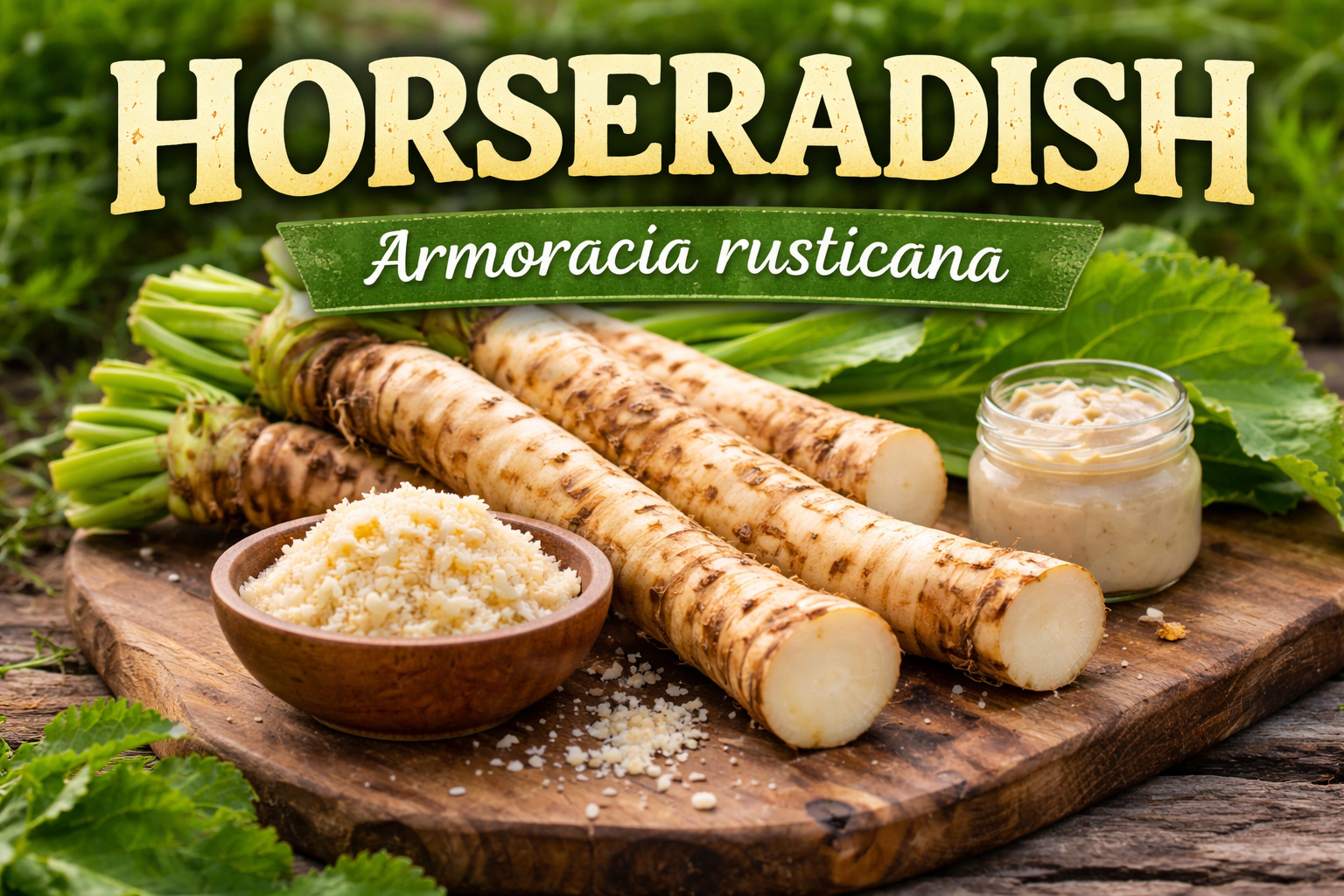
Horseradish (Armoracia rusticana) is a hardy perennial plant in the Brassicaceae family, the same botanical family that includes mustard, cabbage, broccoli, and wasabi. The plant is best known for its large white taproot, which produces a sharp, pungent flavor when grated or crushed. That heat is not spicy like chili peppers; instead, it creates a nose-clearing, sinus-tingling intensity caused by volatile compounds released when the root is broken. Because of its bold flavor and natural medicinal properties, horseradish has been valued for centuries, and today many people explore horseradish benefits and uses in both cooking and traditional herbal remedies.
For centuries, horseradish has served as both a culinary ingredient and a medicinal herb, valued for its strong flavor and natural health properties.
Origins and Early History
Horseradish is believed to have originated in Eastern Europe and Western Asia, where it grew wild along riverbanks and damp soils. Archaeological and historical records suggest that it has been used for over 3,000 years.
Ancient Civilizations
Some of the earliest references to horseradish appear in the ancient Mediterranean world.
- Ancient Egyptians are believed to have used horseradish as early as 1500 BCE, both as food and medicine.
- Greek physicians, including Hippocrates, recommended horseradish for back pain and respiratory ailments.
- The Greeks also used it as a medicinal tonic and sometimes grated the root to mix with vinegar.
The plant later spread throughout Roman territories. Romans valued the root for its digestive and warming properties, often incorporating it into sauces and herbal remedies.
Development in Europe
Horseradish became especially popular during the Middle Ages in Central and Eastern Europe, particularly in regions that are now:
- Germany
- Poland
- Hungary
- Austria
- Russia
Farmers began cultivating the root intentionally rather than harvesting it from the wild.
By the 1500s, horseradish had become a common condiment in Europe. It was frequently grated and mixed with vinegar or cream to create sauces served with meats and fish.
The name “horseradish” likely evolved from the German term “Meerrettich.” When English speakers encountered the plant, the word was sometimes translated or altered, and the term “horse” may have been added to imply a strong or coarse variety of radish.
Horseradish in America
European settlers brought horseradish to North America in the 1700s. German immigrants in particular helped popularize its cultivation.
By the 1800s, horseradish was widely grown in the United States. It became especially prominent in the Midwest, where soil and climate conditions proved ideal.
Today, the majority of American horseradish is grown in the region around Collinsville, Illinois, which proudly calls itself the “Horseradish Capital of the World.”
Culinary Uses
Horseradish is best known as a condiment and flavoring agent. The root is typically grated and combined with vinegar to stabilize its flavor.
Common culinary uses include:
Classic Condiments
- Prepared horseradish (grated root with vinegar and salt)
- Horseradish cream sauce
- Cocktail sauce for seafood
- Horseradish mustard
Traditional Dishes
- Roast beef and prime rib
- Smoked fish
- Bloody Mary cocktails
- Deviled eggs
- Potato salads
In Eastern Europe, horseradish often accompanies sausages, cured meats, and pickled dishes.
When freshly grated, horseradish produces a powerful aromatic heat, but the flavor fades quickly once exposed to air. Vinegar is commonly added to preserve its sharpness.
Medicinal and Traditional Uses
Historically, horseradish was valued as a natural medicine.
Traditional herbal uses include:
Respiratory Relief
Horseradish has long been used to help clear sinus congestion and respiratory passages. The strong vapors stimulate mucus flow and help open airways.
Digestive Aid
The root stimulates digestive enzymes, making it useful for improving digestion and appetite.
Antibacterial Properties
Horseradish contains natural compounds with antimicrobial effects, which historically made it useful for fighting infections.
Circulation and Warming
The root produces a warming sensation in the body and has been used to stimulate circulation.
Some herbal traditions used grated horseradish as a poultice to relieve joint pain and muscle aches.
Active Compounds and Nutritional Value
Horseradish contains several beneficial plant compounds, including:
- Glucosinolates – sulfur compounds also found in mustard and broccoli
- Allyl isothiocyanate – responsible for the plant’s pungent aroma and antimicrobial effects
- Vitamin C
- Potassium
- Calcium
These compounds contribute to horseradish’s immune-supporting and antimicrobial properties.
Cultivation
Horseradish is a hardy perennial that grows easily in temperate climates.
Key growing characteristics:
- Prefers cool climates
- Thrives in moist, well-drained soil
- Propagated from root cuttings rather than seeds
- Harvested in late fall or early spring
Because the plant regrows easily from leftover roots, gardeners often find that once planted, horseradish can become very persistent in the garden.
Modern Uses
Today horseradish continues to be used worldwide in several forms:
- Culinary sauces and condiments
- Herbal remedies
- Natural antimicrobial preparations
- Cocktail ingredients
- Gourmet mustards and spreads
It is also used in some natural food preservation techniques due to its antimicrobial compounds.
Recipe 1: Easy Homemade Horseradish Sauce
This classic horseradish sauce is simple to make and delivers a bold, tangy flavor that pairs perfectly with roast beef, steak, sandwiches, or seafood. Fresh horseradish provides the signature sinus-clearing kick, while sour cream balances the heat with a smooth, creamy texture.
Ingredients
- ½ cup prepared horseradish (freshly grated or store-bought)
- ½ cup sour cream
- 1 tablespoon Dijon mustard
- 1 teaspoon white vinegar or lemon juice
- ½ teaspoon salt
- ¼ teaspoon black pepper
Instructions
- In a small bowl, combine the horseradish and sour cream.
- Add the Dijon mustard, vinegar, salt, and black pepper.
- Stir well until the mixture is smooth and fully blended.
- Refrigerate for at least 30 minutes to allow the flavors to develop.
Serving Ideas
- Serve with prime rib or roast beef
- Spread on sandwiches or burgers
- Mix into deviled eggs or potato salad
- Add a spoonful to a Bloody Mary cocktail
Recipe 2: Creamy Horseradish Mashed Potatoes
Horseradish adds a subtle kick to traditional mashed potatoes, creating a flavorful side dish that pairs wonderfully with grilled meats or roasted vegetables.
Ingredients
- 2 pounds potatoes, peeled and cubed
- 4 tablespoons butter
- ½ cup milk or cream
- 2 tablespoons prepared horseradish
- ½ teaspoon salt
- ¼ teaspoon black pepper
- Optional: chopped chives or parsley for garnish
Instructions
- Place the cubed potatoes in a pot of salted water and bring to a boil.
- Cook for 15–20 minutes, or until the potatoes are fork-tender.
- Drain the potatoes and return them to the pot.
- Add the butter and milk, then mash until smooth.
- Stir in the horseradish, salt, and pepper.
- Garnish with chopped chives or parsley before serving.
Serving Ideas
- Perfect with steak, roast chicken, or pork chops
- Excellent alongside smoked brisket or barbecue
- Great for holiday dinners
✅ In short:
Horseradish is an ancient root plant that originated in Eastern Europe and Western Asia. Over thousands of years it evolved from a wild medicinal herb into one of the world’s most recognizable pungent condiments. Its bold flavor, natural medicinal qualities, and easy cultivation have ensured its place in kitchens and herbal traditions around the world.
Got a tip, question, or story to share? Leave a comment below or reach out through our contact form.

Ready to experience the bold flavor of this powerful root? Browse horseradish roots and herbal products in our store.
One response to “Horseradish (Armoracia rusticana) Benefits And Uses”
Very good article. My dad always great horseradish and mine will be ready to harvest this fall.