
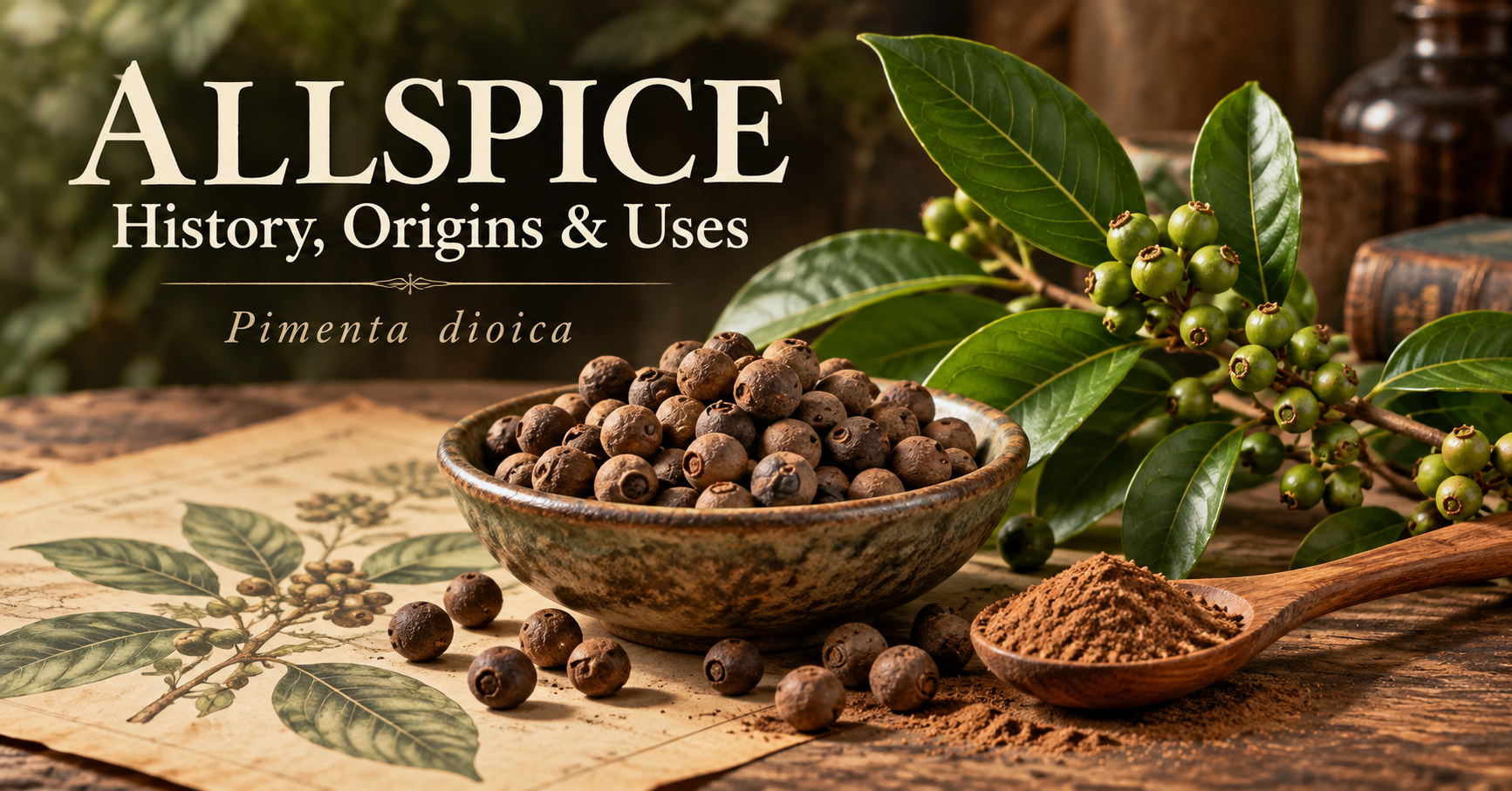
Allspice history and uses connect tropical forests, Indigenous food traditions, Jamaican kitchens, and the modern cocktail glass. Open a jar, and its aroma suggests cloves, cinnamon, nutmeg, and a little pepper. Yet those familiar notes come from a single plant. Allspice is the dried, unripe berry of Pimenta dioica, an evergreen tree in the myrtle family. Its deceptively simple appearance hides a remarkably versatile ingredient. [1, 2]
Perhaps you know it from holiday baking. Perhaps you have tasted its warmth in jerk seasoning or a rum cocktail. Either way, this small brown berry offers much more than a supporting role in the spice cupboard. Understanding where it comes from also reveals why its story deserves more care than the familiar claim that a European explorer “discovered” it.
Where Does Allspice Come From?
Allspice is native to southern Mexico, Central America, and the Caribbean. Its natural range includes countries such as Belize, Guatemala, Honduras, Cuba, and Jamaica. Although Jamaica became especially closely associated with the spice, the plant’s homeland extends well beyond one island. It belongs to the botanical heritage of tropical America. [3]
The tree produces aromatic foliage, small pale flowers, and berries that change color as they mature. Growers harvest the fruit while it is still green, then dry it for use as a spice. The familiar brown “peppercorn” in the kitchen is therefore a dried berry, rather than a seed harvested from a pepper vine. [1]
Several common names reflect that resemblance. You may encounter allspice as Jamaica pepper, pimento, or pimienta gorda. However, Jamaican pimento is different from the red pimiento pepper used in stuffed olives and cheese spreads. The shared names can cause confusion when reading older recipes or shopping for ingredients. Checking the botanical name, Pimenta dioica, helps identify the right plant. [4]
Who First Grew Allspice?
The earliest users were Indigenous peoples within the plant’s native region. Historical accounts describe people seasoning food and cacao drinks with its berries before European trade carried the spice abroad. The Maya are among the peoples associated with its early use. These traditions place allspice within an established food culture, rather than treating it as an ingredient that gained value only after outsiders encountered it. [5]
However, the question of who first grew allspice needs a careful answer. Available evidence does not identify one first farmer, a definite date of domestication, or a single civilization that can confidently receive all the credit. Gathering berries from wild trees, protecting productive trees, and planting an orchard represent different relationships with a plant. They do not necessarily leave equally clear historical records.
Consequently, it is more accurate to describe allspice as an Indigenous American spice with a long history of use than to assign it a neat invention story. The distinction may seem small, but it preserves something important: people understood and valued this tree before its berries appeared in European spice shops.
How Allspice Reached European and American Kitchens
Kew identifies a November 1492 entry in Columbus’s journal as a possible early written reference to allspice. In the account, Indigenous Cubans recognized something resembling the pepper he showed them. Kew suggests that the local plant was probably allspice, since true black pepper originated in Asia. The identification remains an interpretation, so it should not become an exact “discovery date.” [1]
Later overseas trade helped introduce the spice to new kitchens. Its English name captured its appeal: one berry seemed to combine several familiar seasonings. In colonial North America, allspice also offered an economical alternative to buying certain imported spices separately. Meanwhile, Jamaica’s association with its production helped establish the enduring name “Jamaica pepper.” [5]
Its culinary reach eventually included European baking and Middle Eastern meat dishes. That range makes sense once you taste it. The same warming aroma that complements fruit and sugar can also deepen a savory sauce. Allspice does not need to dominate a recipe to make its presence felt. Often, its value lies in the rounded background flavor that makes a dish seem more complete.
Allspice Uses in Cooking and Drinks
Allspice has a prominent place in Jamaican jerk seasoning, where it contributes aromatic depth alongside other seasonings. Its appeal also extends to pastries, puddings, meat dishes, and rum-based pimento dram. The latter, also called allspice dram, gives bartenders a concentrated way to introduce the spice into drinks. [5]
Use the form that suits the recipe. Whole berries work well when you plan to steep and strain. Ground allspice works better when you want the flavor distributed throughout a mixture. For example, a smooth cake batter needs a different approach from a pot of simmering stock. [6]
| Preparation | Useful form | Practical application |
|---|---|---|
| Cakes, cookies, and pies | Ground | Mix with the dry ingredients for even distribution. |
| Meat rubs and seasoning blends | Ground | Combine with the other seasonings before applying. |
| Stocks, stews, and brines | Whole | Infuse during cooking and remove before serving. |
| Warm cider and spiced drinks | Whole or lightly crushed | Steep, taste, and strain. |
| Cocktail syrups | Lightly crushed | Extract into the syrup, then filter out the berries. |
For a first experiment, choose a recipe you already know. A little allspice in baked apples or a familiar spice rub makes the difference easier to recognize. Likewise, when developing a drink, try a small sample before flavoring the full batch. That approach lets you adjust the balance without committing every ingredient at once.
Traditional Uses and the Compounds Behind the Aroma
Traditional herbal practices have used allspice for digestive complaints. This history belongs in the plant’s story, but historical use does not establish that a spice treats a medical condition. A culinary ingredient, a concentrated extract, and an essential oil are also different preparations. Claims about one should not automatically transfer to the others. [1, 4]
Eugenol is an important constituent of allspice’s volatile oil and contributes to its characteristic aroma. Researchers have investigated allspice oils and extracts for biological activity. For example, laboratory research has examined antioxidant and antifungal effects of leaf essential oil. These experiments can help identify compounds worth studying, but they do not demonstrate that adding allspice to dinner prevents or cures disease. [4, 7]
Nutritionally, allspice contains fiber and minerals, but ordinary culinary portions are small. Its most practical contribution to a meal is flavor. Treat concentrated essential oil separately from the kitchen spice; it is not a teaspoon-for-teaspoon substitute. Eugenol-rich preparations can cause irritation, and excessive exposure can be harmful. [4]
For everyday use, the simplest reason to enjoy allspice is also the strongest: it makes many foods and drinks taste good.
Growing and Harvesting Pimenta dioica
Allspice is a tropical evergreen tree, not a small annual herb. Missouri Botanical Garden lists it for USDA hardiness zones 10–12. Gardeners in colder climates therefore need protected conditions rather than expecting it to survive an ordinary winter outdoors. A container plant can be an interesting botanical project, but growing foliage and producing a dependable berry harvest are different goals. [8]
Fruit production introduces another consideration. Allspice trees are generally functionally male or female, and female trees need a suitable pollen source. A single attractive plant does not guarantee a crop. Seed-grown trees also take years to reach flowering age. [8, 4]
Propagation requires fresh seed from ripe fruit. The dried berries sold as a kitchen spice are unsuitable planting material. Once trees produce fruit, growers collect mature but still green berries and dry them to create the commercial spice. [4]
The plant has uses beyond its fruit. Its leaves can flavor soups and sauces, while its wood supplies aromatic smoke for cooking. These applications help explain why the living tree holds culinary value beyond the contents of a spice jar. [2]
Two Simple Ways to Try Allspice
These original recipe suggestions offer an easy introduction to the flavor. Begin with the amounts below, then adjust future batches to your taste.
Allspice and Orange Cocktail Syrup
Ingredients
- ½ cup water
- ½ cup granulated sugar
- 1 teaspoon whole allspice berries, lightly crushed
- 1 strip orange peel, with minimal white pith
Method
- Combine the water, sugar, and allspice in a small saucepan.
- Warm gently, stirring until the sugar dissolves. Simmer gently for 3 minutes.
- Remove from the heat, add the orange peel, and steep for 10 minutes.
- Taste a cooled spoonful. Steep a little longer if you prefer a stronger flavor.
- Strain through a fine sieve, cool, and refrigerate in a clean, covered container. Make a small batch for prompt use; this is not a shelf-stable preserve.
Serving idea: Start with 1–2 teaspoons in a glass of sparkling water with a squeeze of lime. You can also test a little in a rum drink or drizzle it over sliced fruit.
Warm Allspice Apples
Ingredients
- 2 medium apples, cored and sliced
- 1 tablespoon butter
- 1 tablespoon brown sugar
- ¼ teaspoon ground allspice
- 2 tablespoons water
- A small pinch of salt
Method
- Melt the butter in a skillet over medium-low heat.
- Add the apples, brown sugar, allspice, water, and salt.
- Cover and cook gently for 5 minutes.
- Uncover and cook for another 3–5 minutes, stirring occasionally, until the apples are tender. Add a splash of water if the pan becomes dry.
- Serve warm over oatmeal, pancakes, yogurt, or ice cream.
Serving idea: Try the apples without other spices on your first batch. That makes it easier to notice the different notes within allspice itself.
Frequently Asked Questions About Allspice
Is allspice a blend of spices?
No. Allspice is one spice made from the dried, unripe berries of Pimenta dioica. Its aroma resembles several other spices, which explains its name. [2]
Where did allspice originate?
It is native to southern Mexico, Central America, and parts of the Caribbean. Jamaica is an important part of that homeland, but it is not the only native location. [3]
Who first cultivated allspice?
No securely established first cultivator or domestication date can be named. Indigenous peoples used it before European contact, but early use does not by itself prove who first planted it as a crop.
Is allspice the same as cloves?
No. They are different spices. Allspice has a clove-like note within a broader aroma that also suggests cinnamon, nutmeg, and pepper. [2]
Can I use whole berries instead of ground allspice?
Whole berries suit recipes that allow steeping and straining. For baking or a smooth seasoning mixture, grind the berries first. Remove whole berries from the finished dish before serving. [6]
How should I store allspice?
Keep it in a tightly closed container away from heat, moisture, and direct light. Whole berries generally retain their flavor longer than pre-ground allspice. Grind small amounts as needed. [6]
Bring a Little Botanical History to Your Kitchen
Exploring allspice history and uses turns an ordinary spice jar into a connection with places, plants, and food traditions. It also offers a simple invitation to experiment. Flavor a small batch of syrup, warm a skillet of apples, or add a fresh dimension to a familiar savory dish.
Explore allspice at Spirit of Wormwood and discover where this versatile botanical fits into your kitchen.
How do you use allspice—baking, savory cooking, or drinks? Share your favorite pairing in the comments.
Sources and Further Reading
- Royal Botanic Gardens, Kew — Pimenta dioica species profile: botanical description, early European account, and traditional uses.
- Kew — Christmas spice makes all things nice: flavor, leaves, and wood.
- Kew — Pimenta dioica native distribution: native range.
- PROSEA — Pimenta dioica: propagation, harvesting, chemistry, and preparation distinctions. Historical trade figures in this older reference are not used as current statistics.
- Herb Society of America — Allspice: Four Spices in One: culinary history and applications. Specific first-cultivator and mandatory bird-germination claims are not adopted here.
- Food & Wine — Allspice Is Actually a Berry: whole versus ground culinary use and storage.
- Sarathambal et al. — Antioxidant and antifungal properties of Pimenta dioica leaf essential oil: laboratory research, not clinical proof of treatment benefits.
- Missouri Botanical Garden — Pimenta dioica: growing zones and pollination.
Leave a Reply